Safeguarding Critical Spare Parts with Mike Gaber from Cortec
Who It’s For
This session is useful for:
Maintenance Manager
Reliability Engineer
Mechanical Engineer
Corrosion Engineer
Asset Integrity Manager
Operations Manager
Inventory Control Manager
About the Speaker
Mike Gaber brings over 30 years of experience in the corrosion control industry to Cortec. Formerly the Regional Manager for Michigan and Minnesota, he now serves as the Vice President of Sales for North America. Recently, he has taken on the role of Strategic Growth Director, focusing on expanding into the Mexican market.
Cortec is a specialty chemical manufacturer founded in 1977, with their headquarters in St. Paul, Minnesota.
Cortec is a vertically integrated manufacturer of vapor phase corrosion inhibitors, migrating corrosion inhibitors, and related technologies. We will briefly discuss how these technologies function. Quality is a top priority for us, and we are ISO 9001 certified. Additionally, we earned our ISO 14001 environmental certification in the mid-90s, highlighting our long-standing commitment to sustainability and environmental responsibility. We also have an ISO 17025 accredited laboratory.
We have 5 US production facilities and five international facilities, including Canada, Europe, and Southeast Asia. Our core manufacturing are products that remove, prevent, and reduce rusting of metals and corrosion. So we’re talking more than 500 products today, more than 60 patents, and as we mentioned, a real focus on the environment and environmentally and sustainable technologies. Global reach in more than 100 countries.
We sell through distributors like USI all around the world globally. We prefer not to have direct business relationships with the end customer. Our focus is to support those distributors, many of which have gone through a lot of technical training.
Our role is to collaborate closely with customers in the field to ensure we deliver the best solutions to meet their objectives. A great example of our global responsiveness is our partnership with Caterpillar, where we are part of their approved supplier network for corrosion engineering. We are committed to being on-site anywhere in the world within 48 hours of a corrosion event. One of the most exciting aspects of our job is being able to respond quickly—just a few clicks and some emails or texts, and the next day, we can have someone at a plant in India. It’s a powerful capability that we can offer to all our clients.
How vapor phase corrosion inhibitors work:
We don’t need to manage moisture like traditional methods do. I recently visited a customer in Mexico who is still using foil barrier bags with desiccants. While this approach can be effective, if there’s even a small pinhole in the foil or the desiccants become saturated, corrosion protection is compromised.
Our technology works differently; it utilizes a polarized molecule. Since water is also a polarized molecule, with positive and negative ends that are attracted to metal surfaces, it functions similarly to a magnet.
What sets our technology apart is that the attraction strength of a VPCI molecule is about 1,000 times stronger than that of water. When we introduce our technology into a system, it targets the metal surface and forms a strong bond in its purest form, such as in packaging applications. Once you open that package, the vapor inhibitor will dissipate into the air.
The smaller end of the molecule is attracted to the metal, while the larger end is hydrophobic. Over the years, we’ve had many customers contact us in a panic after noticing water inside their packaging. We reassure them by asking, “Do you see any rust?” The usual response is no, and we explain that this is perfectly fine. We anticipate cycling condensation and significant temperature fluctuations, allowing us to custom design our applications for various conditions, including indoor/outdoor export shipping.
Here’s another visual to help illustrate our technology. The bottle on the left contains a piece of steel wool that is partially submerged in water, with a few drops of a vapor phase corrosion inhibitor specifically designed for water-based systems. We use steel wool for this demonstration because it rusts very quickly.
The bottle on the right is filled with plain water, which typically starts to turn orange in about 20 minutes. The bottle on the left shows that the vapor phase inhibitor remains effective even in direct contact with water at the interface and in the airspace. I’ve carried bottles like this for years, some even 10 to 20 years old, and because the bottle is sealed, the corrosion inhibitor remains contained and effective over time.
Now, let’s move on to the main topic for today. Having worked in this industry for 30 years, I’ve seen a shift in preservation practices. In the early days, we often advised using our products during preservation but emphasized the need to clean them out afterward. A great example of this is a gearbox.
Previously, we would add an oil containing a vapor phase corrosion inhibitor to the gearbox, but that oil wasn’t compatible for operational use. As a result, when customers wanted to put the gearbox back into service after storage, they had to thoroughly drain the corrosion-inhibiting oil and replace it with operational oils.
This highlights the evolution of our approach. Traditional methods, like applying grease, using nitrogen blankets, covering with tarps, or simply spraying WD-40—something my grandfather would have done—are not ideal corrosion inhibitors. While these methods can be effective, they often lead to complications and additional work for customers later on.
Our technologies are designed to be more compatible with assets, minimizing or eliminating the need for cleanup, so you can quickly return your products to service. This involves aligning preservation methods with the specific applications.
Let’s discuss internal spaces, such as air applications, flow paths, turbines, exhaust systems, diesel engines, and air or compressed air tanks. In the past, these were often treated with oil-based products or temporary coatings. Today, Cortec offers innovative solutions. I won’t go into detail about all our products, as no one wants to hear 500 different descriptions, but we have a proven water-based fogging product known as 337.
For air-based systems, like a diesel engine’s exhaust system, you can fog this product inside, seal the ends, and achieve corrosion protection for potentially years. Traditionally, VCI oil would be fogged inside diesel engine exhaust systems, which is effective but leads to a significant black plume of burning oil when the engine is started for the first time.
It’s crucial to match the technology to the application. For oil-based systems, like gearboxes or engine internals, we now have products that are operationally compatible, meaning you won’t need to remove them. In some cases, we even incorporate our technology into test stand oil so that while testing a gearbox or engine, you’re also benefiting from corrosion protection in both contact and vapor phases.
Once you ship that item, it’s protected against rust, similar to how the steel wool in bottles works. We achieve excellent corrosion protection in the liquid stage, and as the oil drains down the sides and settles at the bottom, the vapor inhibitor takes over, ensuring robust protection.
This principle applies to fuels as well. We offer products compatible with diesel and traditional fuels that include a vapor phase component. For instance, you might need to add just a pint or even a cup of our technology to a large 50-gallon tank to maintain protection until it’s used.
Some of our most rapidly growing technologies are in water-based applications, particularly for coolant passages. Whether you’re testing a chiller unit for a data center or providing corrosion protection for their operational water systems, we’ve developed exceptional technologies for these scenarios.
I’ve had the opportunity to visit many customers and share that we have solutions that work effectively at one-third the dosage while providing twice the protection—much more efficient and cost-effective. There aren’t many instances in our careers where we can offer something that is both significantly cheaper and more effective. Our 649 series is specifically designed for water-based applications.
Let’s revisit diesel engines for a moment. We’ve successfully implemented this technology in engine testing worldwide for companies like Caterpillar, John Deere, and Cummins, which is currently trialing it. There are excellent applications and a solid track record. We also provide solutions for cooling towers and other areas typically associated with water treatment. Our approach ensures that preservation aligns with the internal space, so we don’t have to worry about any potential oversights later on.
This represents a significant advancement in our preservation technology over the past dozen years. Once we’ve addressed the internal components, we then focus on the external surfaces—particularly unpainted areas that are prone to corrosion. It’s crucial to consider factors like storage conditions (indoors or outdoors), overseas shipping, and duration. We collaborate with each customer to develop a tailored plan.
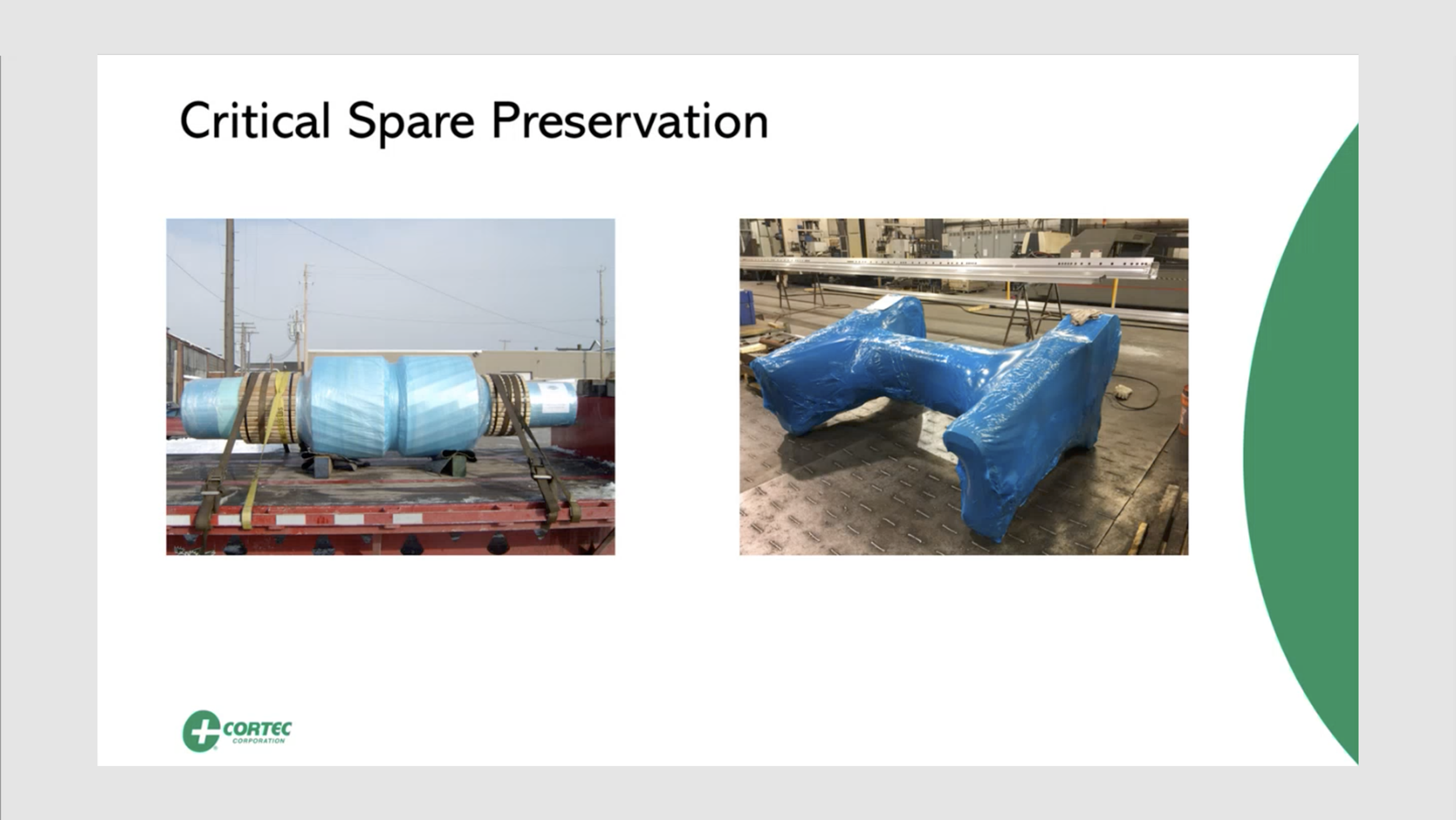
This is where VPCI packaging comes into play, along with removable or temporary coatings and permanent coatings that utilize vapor phase corrosion technologies. If you move to the next slide, there should be a picture of the packaging.
Here are a couple of examples. On the left, we have a gearing journal that may include both vapor phase corrosion-inhibiting packaging and possibly a light-duty or secondary surface treatment, depending on the environment. The part on the right is for loader equipment, specifically ground-engaging machinery, and is wrapped in plastic that contains vapor phase inhibitors.
The advantage of these technologies is that they release from the surface, so when you remove the packaging, the part is clean and dry, ready for immediate use without affecting weldability or other processes.
With asset preservation, we now offer programs that are easy to apply, implement, and very cost-effective.
If you have any questions, reach out to Unconventional Solutions at www.usigroups.com or call directly (248) 735-7000.
asset control asset corrosion Corrosion Protection engines gearboxes migrating corrosion inhibitors vapor phase corrosion inhibitors