Concrete Repair Systems for Safety and Longevity with Chris Mathson from Resimac
Who It’s For
This session is useful for:
Maintenance Engineers
Plant Managers
Asset Management Technicians
Marine Surveyors
Pipefitters
Pump Repair Engineers
About the Speaker
Chris Mathson is the Business Development Manager, at Resimac Ltd., bringing 20+ years of experience in coatings.
Concrete failures may seem minor, but in industrial and commercial settings they create serious safety and financial risks. Small surface defects — a divot, a cracked nosing, or a spalled patch — are common trip hazards: a stiletto heel or a toe catching on an uneven slab can cause a fall, and forklifts hitting a change in elevation can spill loads or even tip.
Slips, trips and falls are the top OSHA-reportable incident type year after year; Aberdeen research estimates the employer cost for each reported incident at roughly $10,000–$50,000. That shows how even seemingly small concrete issues can carry outsized consequences.
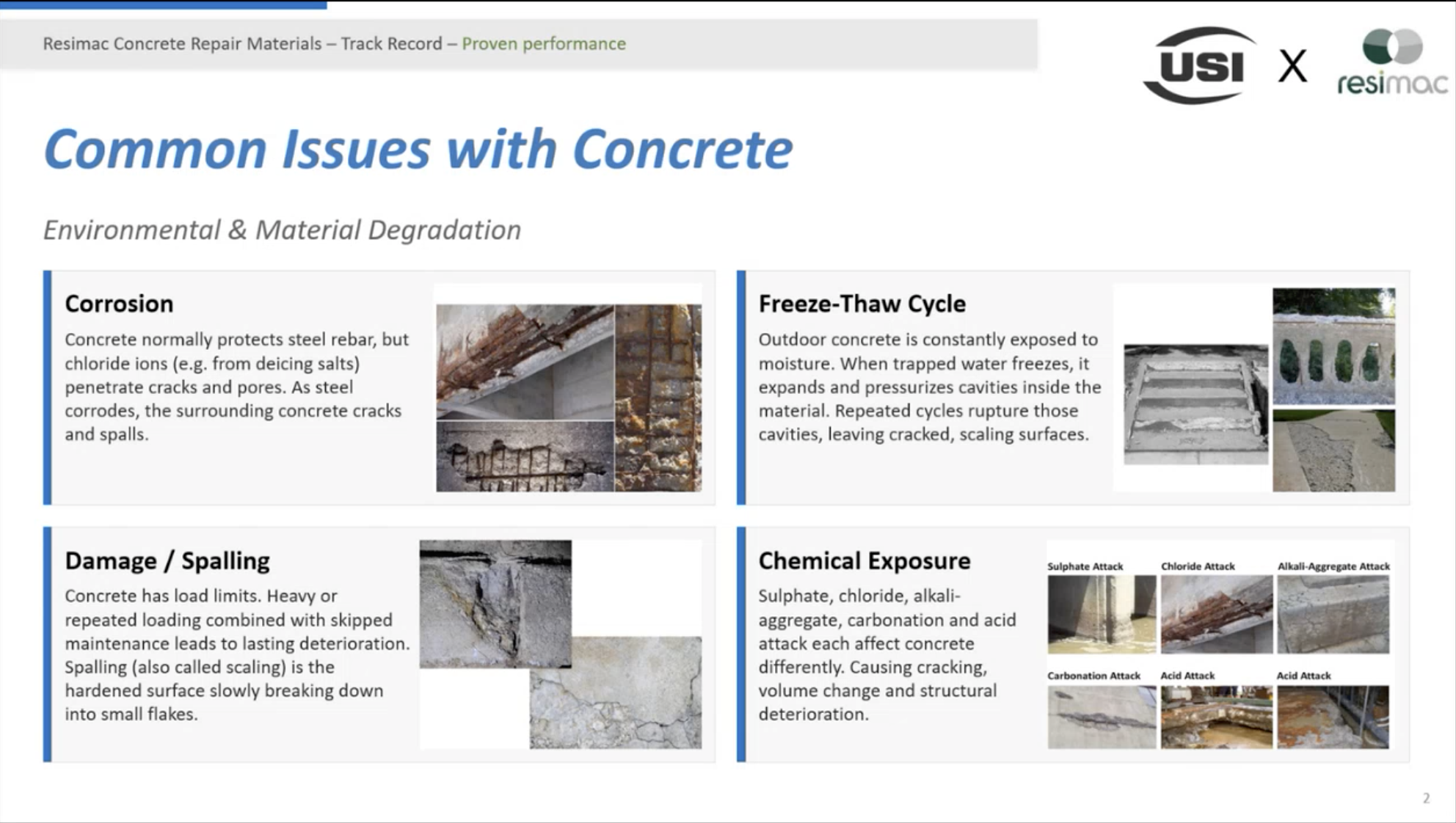
Beyond immediate safety, concrete’s porosity creates long-term problems. Acid or chemical spills can seep into the substrate, accelerating deterioration and potentially contaminating soil — a regulatory and remediation headache on top of repair costs.
Because of these risks, routine inspection and timely repair of concrete — from leveling slabs and repairing nosings to sealing and chemical protection — should be a priority for any plant, warehouse, or commercial facility.
Most calls we get come down to two questions: what’s causing the damage, and how do we fix it for good? At Resimac, concrete repair is the foundation — literally — of our system. Our repair products create a uniform, durable substrate so protective barrier coatings applied afterward will perform as intended.
There are many concrete repair options on the market, but the key difference with Resimac is longevity and resistance to harsh exposures. Ordinary cementitious patches rely on simple water-and-binder adhesion; they often fail when moisture in the slab freezes and expands. In climates with repeated freeze–thaw cycles, weak repairs pop loose after a season or two.
Our goal is one permanent fix, not a short-term patch. We focus on materials and application methods that bond deeply, tolerate moisture movement, and hold up to freeze–thaw and chemical exposure — so you don’t have to keep calling back.
Joints, cold joints and slab separation are common culprits behind concrete failures in warehouses and commercial facilities. Differential settlement or poorly tied pours creates small ramps and gaps that are easy to miss — until a forklift hits one. Even a slight elevation change can jolt a lift, spill expensive loads, or, worst-case, tip the machine. That’s why repairs must be targeted: not every crack gets filled, but every hazardous joint or separation should be addressed.
Many DIY or big‑box cementitious patches rely on water‑based binders that often fail under repeated traffic and freeze–thaw cycles. For high‑traffic, high‑risk areas we use epoxy‑resin repair systems. Epoxy penetrates and chemically bonds with the substrate, producing a tenacious bond — pull‑off tests frequently separate the surrounding concrete before the repair fails.
Beyond adhesion, load resistance matters. Standard concrete often tests around 3,000–5,000 PSI; our epoxy‑quartz repair blends commonly deliver 12,000–15,000+ PSI equivalent performance, plus superior wear resistance from the quartz aggregate. In short: properly specified epoxy repairs provide durable, long‑lasting surfaces that keep equipment stable and people safe — and save repeated patchwork down the road.
Resimac 570 and 571: quick, dependable concrete repairs
Resimac 570 — fast, localized repairs
Resimac 570 is designed for small, high‑use repairs where speed matters. It’s self‑priming (no primer required), wets out and rebuilds the substrate, trowels smoothly, and reaches initial hardness in about 45 minutes. At 70°F it’s safe for forklift traffic in roughly 4 hours, so small damaged areas—broken handrail anchors, chipped slab edges, or localized spalls—can be restored and returned to service the same day. Packaged for convenient handling, 570 works bucket‑to‑bucket for slightly larger patches too.
Resimac 571 — vertical and overhead rebuilds
Resimac 571 is formulated for vertical and overhead concrete work: walls, tank surfaces, bridges, and overpasses. It’s packable to roughly 2–3 inches without slumping, bonds directly to sound concrete (no rebar exposure or pinning required), and builds without sag. Cure profile is slower than 570—mechanical hardness develops over several hours—making it ideal where workability and non‑slump performance are essential.
Bottom line: use 570 when you need a fast, return‑to‑service patch; choose 571 when you need a stable, buildable solution for vertical or overhead concrete repairs.
Resimac 576 vs 577 — when to choose which for larger repairs
Resimac 570 handles fast, localized patches. For larger resurfacing or full‑bay repairs, you want a product with more working time — enter Resimac 576.
- Designed for larger areas: floor resurfacing, secondary containment, or re‑screening entire slabs.
- Longer workability (around 20–25 minutes) so you can trowel and finish consistently over a big area.
- Slower cure than 570, so plan for longer return‑to‑service times before overlaying or heavy traffic.
Resimac 577:
- Formulated identically to 576 in handling and mechanical properties, but uses Enobilac resin as the binder.
- Delivers substantially improved chemical resistance — ideal where aggressive chemicals, solvents, or persistent exposure caused the original damage.
How to choose:
- Use 576 when you need a robust resurfacing product and plan to topcoat later with a chemical‑resistant barrier (typical workflow: repair → cure → primer/coating).
- Use 577 when you want to eliminate extra steps: it can be applied across the area to provide both repair and integrated chemical protection, avoiding the need to return with primers and multiple coating layers. That makes 577 a time‑saving choice for tight schedules (e.g., secondary containment where you need a reliable chemical‑resistant surface quickly).
In short: 576 for large repairs where you’ll follow with a tailored coating; 577 when chemical resistance and a one‑step solution matter most.
QUESTIONS ASKED:
- Where are these products available and only director at retailers?
- What repair materials hold up best in free thaws environments?
- How do you prevent repaired areas from failing differently than the surrounding concrete?
- Are any of these materials compatible with humid environments?
Concrete divots Concrete safety Cracked nosing Forklift elevation OSHA-Recordable Repair concrete Spalled patch Trip hazards