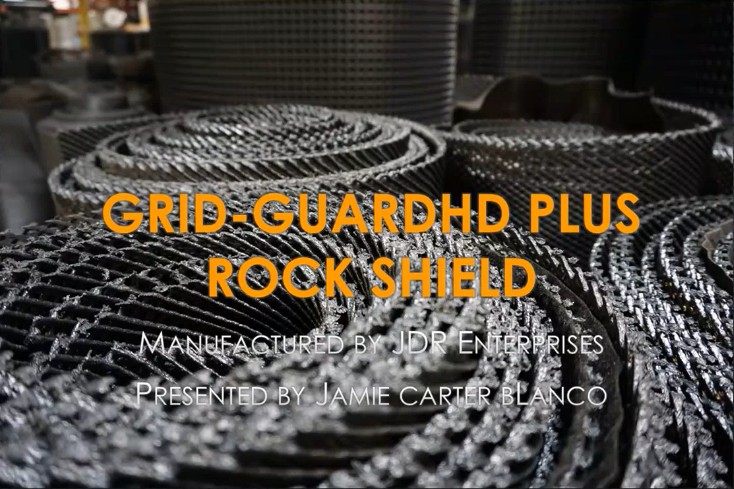
Gridguard HD Plus
Who It’s For
This session is useful for:
Pipeline owners, engineers, corrosion teams, and inspectors evaluating rock shield performance and CP compatibility
Contractors and crews who want easier handling, fewer cold-weather headaches, and faster lowering operations
About the Speaker
Jamie Blanco has worked closely with installers and engineers to translate real-world challenges into practical solutions. She has been with JDR Enterprises for nine years and played a key role in the development and approval of Gridguard HD Plus, serving as a manufacturer’s representative focused on advancing rock shield performance and adoption.
Gridguard is manufactured in Madison, Georgia.
Why Rock Shield Matters
Rock shield is used to:
Protect the coating from rock impact during backfill—and ideally continue that protection after burial
Help prevent coating damage that can lead to long-term corrosion
Support the overall corrosion-control system, including cathodic protection
A “good” rock shield shouldn’t only survive the backfill—it should protect the coating long-term without becoming a contributor to coating failure risks.
Common Challenges (Field + Engineering)
Field challenges crews deal with
Heavy rolls, moisture retention, freezing, and handling problems that slow installation and raise safety concerns
Difficult use with cradles/rollers leading to lost time and money
Engineering concerns
Cathodic protection compatibility is one of the first questions raised with rock shield selection
Thick materials that hold water, abrasion risk against coatings, and unvetted/untested products being used in the field
What to Ask Before You Approve Any Rock Shield
Use these as a quick checklist for your next spec review:
Does the design eliminate void spaces where small fragments can get trapped?
Has it been tested for CP flow during burial and compaction (not just unburied tests)?
Does installation require heat welding—and if so, what are the risks of heat near the coating?
Does it retain moisture or freeze in cold weather, creating handling delays?
Gridguard HD Plus Highlights (At-a-Glance)
Designed for engineering + corrosion teams
6 oz geotextile backing bonded to a bidirectional extruded poly for impact resistance
Geotextile backing intended to assist CP and “will not shield,” with test reports available
Strength comes from the bidirectional poly structure, not “just thickness”
Helps reduce abrasion on the coating and allows water/fines to move around the pipe
Eliminates void space concerns (fragment trapping)
Built for field productivity
Light weight: ~0.41 lbs/sq ft (about half of traditional rock shield, per the talk)
Longer rolls: 50 ft vs. 30 ft traditional
Can be used in rollers/cradles without bunching or tearing, speeding lowering operations
Uses less tape (often about half) and can reduce wrap intervals (commonly up to ~12–18″)
Cold-weather flexibility tested to -40°F to -50°F (including wet/frozen conditioning)
UV protection: ~1.5 years built in, plus additional protection from carbon-black wrapping
Made with up to 24% recycled materials
“Avoid This” — Most Common Field Mistakes
Jamie called out two common install errors that can create downstream issues:
Lip installed “up” instead of down — the lip should be down and wrapped toward the bottom of the pipeline to reduce fragment entry.
Fabric installed outward — ensure the geotextile is against the coating (not facing out).
Q&A Highlights
Other applications discussed:
Gridguard material has been used (or explored) in applications beyond pipeline—including under tanks with anodes, under liners, and behind concrete in other projects.
Hazardous waste / liner cell protection:
A question came up about using it for additional impact resistance in new hazardous waste dump cells where crews currently use geo fabric prior to liners.
High temperature rating:
When asked about “top temp,” Jamie noted there are melt-point values available (start-to-melt vs. fully-melted), and she can provide those specifics.
Have a project coming up (capital or integrity maintenance) and want to compare rock shield options, CP test reports, or best-fit roll sizes?
Contact Unconventional Solutions (USI):
Email: office@usigroups.com
Phone: 248-735-7000